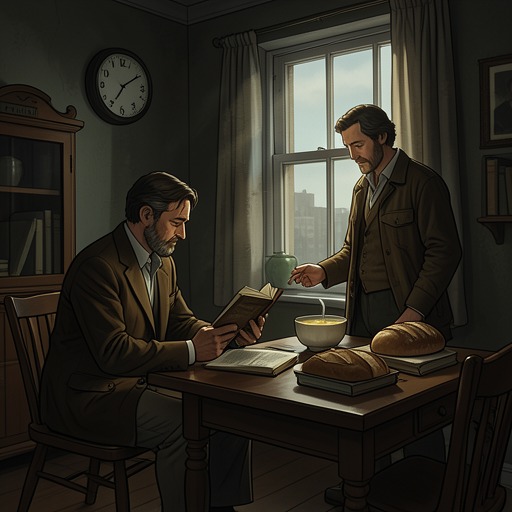
Antek and Hanka
The PeasantsAntek and Hanka’s relationship is a marriage under pressure from the loss of a home, the demands of raising children, and the struggle to keep even a small household afloat. Their bond is marked by a painful mismatch: Hanka seeks conversation and shared responsibility, while Antek withdraws into silence and brooding. Yet the account also shows care passing between them in gestures rather than words, leaving their marriage neither simply united nor wholly broken.
Marriage under pressure
Antek and Hanka are husband and wife with children, and that family responsibility is invoked during the dispute over their place in the household. Hanka insists that Antek must remember his wife and children; his answer, muttered through gritted teeth, acknowledges them without resolving the conflict. The exchange makes the family’s dependence on Antek explicit even as his place within it is unsettled.
The dispute becomes direct when Antek challenges the treatment of his family and threatens to take the matter to court. Maciej Boryna answers with menace, and Hanka rises to object that they will not allow themselves to be wronged. She points to the unequal distribution of land: Antek has received nothing, not even the amount associated with his mother, while he and his family work as if they were hired laborers. Her intervention is both a defense of her household and a demand that its labor and claims be recognized.
Expulsion and the family’s departure
When Maciej Boryna drives Antek’s family out, the departure is carried through without a quarrel or open resistance. They pack their belongings and tie them into bundles. Hanka is nearly overcome by misery, and Antek gives her water and urges her to leave promptly, before his father can see them. His practical attentiveness offers a brief counterpoint to the harshness of the expulsion.
Antek borrows a horse from Kłąb rather than use his father’s, then carries the family’s possessions to Hanka’s father’s home at the far end of the village. Several farmers, led by Roch, come to try to reconcile father and son, but neither accepts their intervention. As the family leaves, Józia Borynianka, her face swollen from crying, serves dinner to Maciej Boryna and Roch. Antek does not look back at the house. He crosses himself, sighs, and drives the heavily loaded cart without speaking, his face pale and his body trembling; Hanka follows on foot with the children and the remaining animals. Her older boy clings to her skirt and cries, while she carries the younger child, drives the cow, geese, and two thin pigs, and laments loudly enough that neighbors come out and accompany them. The separation thus becomes a visible procession of family loss, not merely a transfer of belongings.
Poverty and estrangement
Three weeks after the expulsion, the couple are still living with the injury between them. They do not meet one another’s eyes or speak directly; reproaches remain unspoken, and their faces show both resentment and a hard, proud resolve. Their poverty sharpens this silence. The household has been reduced to potatoes and salt, with no money to spare, and even Jankiel will no longer extend credit. Selling the cow appears to be the next necessity, while Antek refuses to take hired work despite the family’s need.
Their new dwelling makes the change in circumstances concrete. It is a cramped, decaying place with a muddy clay floor, damp walls, a sagging ceiling, and a partition behind which the cows are kept. Hanka’s household possessions and animals are few: a cow, a heifer, a pig, two geese, and a few hens. She completes the chores, dresses the boys, and prepares to go into the village to deal with the merchants, but she hesitates to consult Antek about selling the cow. He sits by the dying fire, staring gloomily ahead, and she watches him anxiously, taking care not to irritate him with the sound of her clogs.
Care, silence, and the cow
Hanka’s private thoughts disclose the loneliness inside the marriage. She believes the hardship is harder for Antek than for other men, and wants to speak kindly, ask what is wrong, and share his sorrow. But his inattention stops her. She feels that the worries and work have fallen on her alone, and longs for even a sign of engagement from him. In her distress, an angry outburst or a reproach would at least show that he was present; his withdrawal instead makes him seem unreachable. This is Hanka’s perception of their life together, and the narrative grounds it in her daily labor and the silence between them.
Her grief breaks through when she goes behind the partition to the cattle. As the skewbald cow pants and licks her head and shoulders, Hanka embraces its neck and mourns the animal’s impending sale. The cow is their mainstay, and losing it means losing the milk and security that might help them endure until spring. Her lament turns into a revolt against their circumstances: Antek will not seek work, though threshing has been offered, and the household can no longer afford even basic provisions. The immediate conflict is economic, but Hanka’s appeal also exposes how little room she has to act when the family’s survival depends on a decision she does not feel able to make without her husband.
When she finally calls Antek’s name sharply, ready to confront him, he looks up with quiet, bloodshot eyes and such sadness that her anger gives way to pity. She asks about the merchants coming for the cow in a softened voice. The shift does not solve their poverty or erase their unspoken grievances. It does, however, show the relationship’s continuing movement between accusation and concern: Hanka’s resolve falters before Antek’s visible sorrow, and her attempt to speak begins again as a gentler question. Their marriage remains burdened by deprivation and estrangement, but this moment makes clear that distress can still draw tenderness out of both of them.